She carried the banner
Joan said she loved her standard forty times more than her sword. She held the white banner in battle so that she herself would not kill.

1412 – 1431
What can be known of Jeanne d’Arc is unusually clear. Clerks wrote down her answers. Soldiers remembered the banner. A village, a campaign, a trial, and a fire — then the long correction of history.
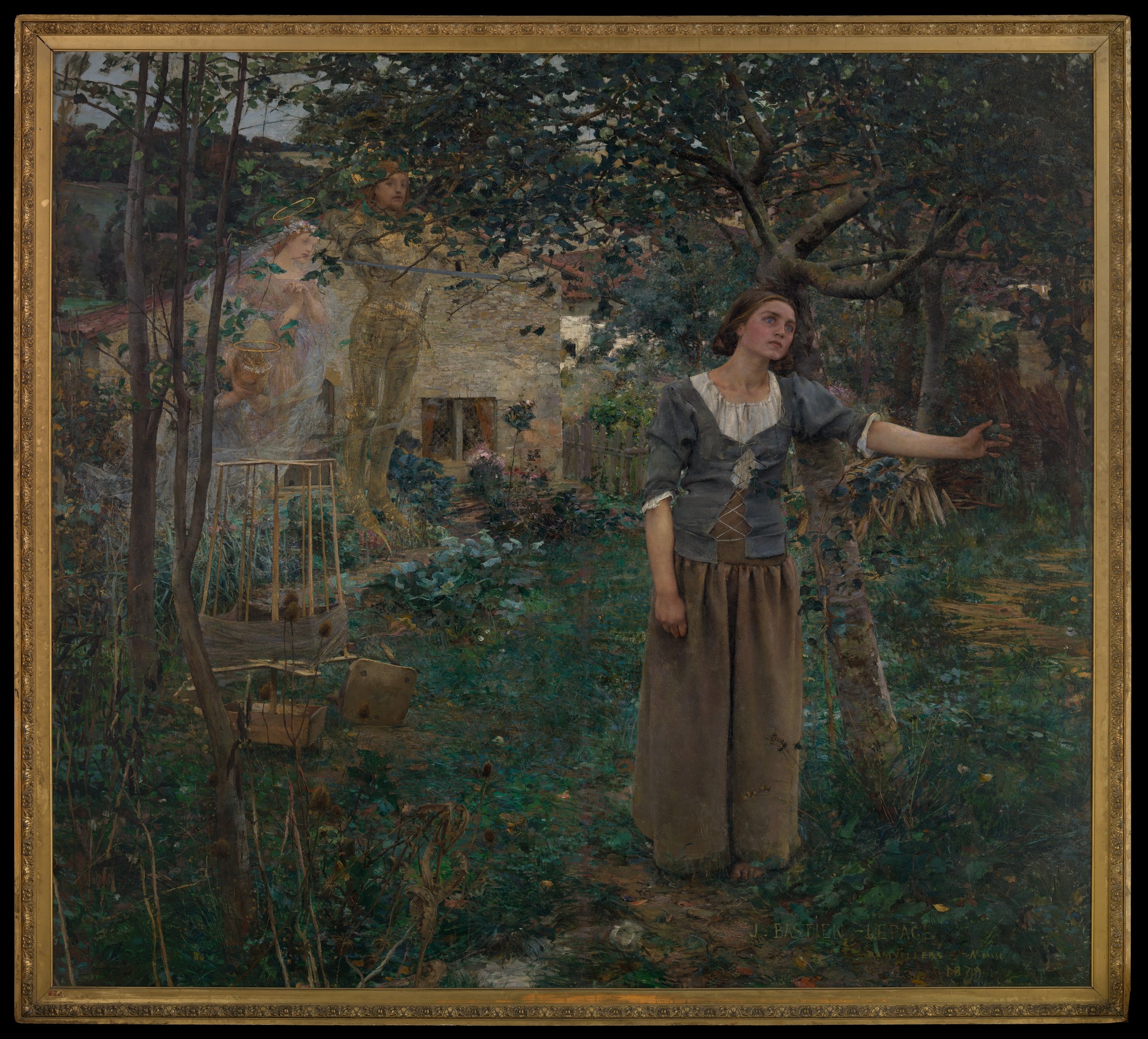
BASTIEN-LEPAGE, 1879
Jules Bastien-Lepage painted the calling as Joan herself described it: a working girl among cabbages and trees, the saints present and almost unseen. She was about thirteen. The voices named a war, a king, and a road she had no worldly reason to take.
TIMELINE
c. 6 January 1412
Jeanne is born to Jacques d’Arc and Isabelle Romée, peasant farmers in Domrémy on the Meuse, in the borderlands of the French kingdom during the Hundred Years’ War. The traditional date is the Feast of the Epiphany.
c. 1425
Around the age of thirteen she first hears a voice from God, later identifying her counselors as Saint Michael the Archangel, Saint Catherine of Alexandria, and Saint Margaret of Antioch. They tell her to remain a good child, go to church, and, in time, to raise the siege of Orléans and bring the Dauphin to Reims.
May 1428 – January 1429
She travels to the garrison town of Vaucouleurs to beg Captain Robert de Baudricourt for an escort to the Dauphin. After a first refusal and a winter of persistence, he relents in January 1429. She cuts her hair, puts on a soldier’s clothes, and rides west.
February – March 1429
At Chinon she is received by Charles, the uncrowned Dauphin. Clerics examine her at Poitiers for three weeks and find no harm in her. She asks only to be allowed to prove her mission at Orléans.
29 April – 8 May 1429
Joan enters the starving city on 29 April. Wounded by an arrow in the shoulder on 7 May, she returns to the field. The English fortress of Les Tourelles falls; on 8 May the siege is raised. Orléans still keeps that day as a civic feast.
18 June 1429
The French army, riding the momentum of Orléans, smashes the English field force at Patay. The Loire campaign is won in a matter of weeks.
17 July 1429
Charles VII is anointed in Reims Cathedral, the ancient coronation church of French kings. Joan stands near him with her white standard — inscribed Jhesus Maria — the mission her voices named now visibly fulfilled.
8 September 1429
An assault on Paris fails. Joan is wounded in the thigh by a crossbow bolt. The court, cautious after victory, does not press the attack.
23 May 1430
Fighting a Burgundian sortie outside Compiègne, she is pulled from her horse and taken prisoner. In November the Burgundians sell her to the English. Charles VII does not ransom her.
9 January 1431
An ecclesiastical court under Bishop Pierre Cauchon, sitting in English-held Rouen, opens proceedings. She is charged with heresy, witchcraft, and wearing men’s clothes. The surviving transcript is one of the most complete records of any medieval trial.
24 May 1431
Shown the scaffold, she signs an abjuration she cannot read. Days later she resumes male clothing in prison — whether for protection or because her voices commanded it — and is judged a relapsed heretic.
30 May 1431
Joan is burned in the Old Market of Rouen. She is about nineteen. Witnesses say she called on the name of Jesus as the fire rose, and asked for a cross to be held where she could see it.
1455 – 1456
At the petition of her mother Isabelle and brothers, Pope Callixtus III opens a nullification trial. In 1456 the Rouen verdict is overturned. Joan is declared innocent of the crimes for which she died.
18 April 1909
Pope Pius X beatifies Joan after the Church accepts miracles of healing attributed to her intercession.
16 May 1920
Pope Benedict XV canonizes Saint Joan of Arc. Her feast is kept on 30 May, the day of her death. She is a patron of France, of soldiers, of prisoners, and of those ridiculed for their piety.
WHAT IS CERTAIN
Joan said she loved her standard forty times more than her sword. She held the white banner in battle so that she herself would not kill.
She dictated letters and signed with a cross, later learning to write her name, Jehanne. The trial clerks preserved her spoken French.
An arrow at Orléans, a bolt before Paris — she had the shafts drawn and went back to the field. She had said beforehand that she would be struck at Orléans.
Latin minutes of the Rouen process survive in full. Almost everything we know of her inner life comes from those questions, asked to destroy her, which instead preserved her voice.
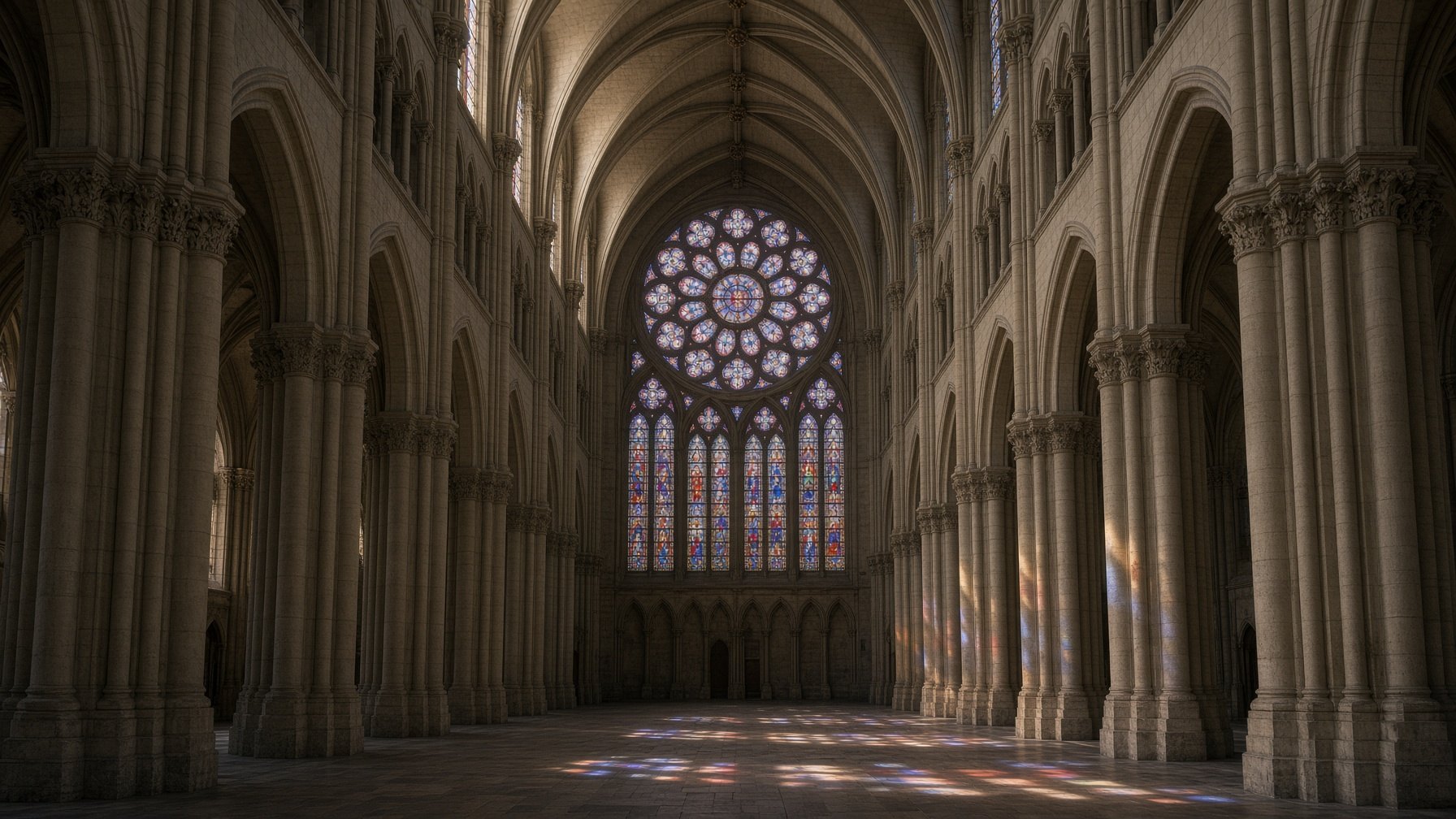
The coronation of 17 July 1429 is the summit of her public work. The trial that opened on 9 January 1431 is the record of her soul. Between them lie a failed assault on Paris, a capture at Compiègne, and a king who did not come. The Church that judged her wrongly judged her again, and this time told the truth.
Principal sources: the Rouen trial and 1456 nullification process; the biography in Encyclopaedia Britannica; the canonization of 16 May 1920 under Pope Benedict XV. Dates of birth follow the traditional Epiphany of 1412.